



- Biological Products Analysis Service
- Preclinical Drug Development
- Solutions
- High-Throughout Gene Knockout Services
- Biopharmaceutical Stability Analysis Service
- PROTAC Drug Off-Target Protein Assessment Service
- Biosimilar Assessment Service
- Generic Peptide Pharmaceuticals Assessment Service
- Research on Media Development and Optimization
- Small Molecule Drug Target Identification and Validation Service
- Vaccine Quality Research and Testing Solutions
- Antibody Drug Analysis Service
- mRNA Drug Analysis Service
- Medical Device Analysis Service
- Proteomics Analysis Service
- Sample Preparation Service
- Protein Analysis Service
- Quantitative Proteomics Service
- Post-Translational Modifications Proteomics Service
- Proteomics Service of Different Sample Types
- Targeted Proteomics Service
- Peptidomics Analysis Service
- Proteomics Bioinformatic Analysis Service
- High-Throughout Proteomics Analysis Service for Gene Knockout
- Olink Analysis Service
- Chemical Proteomics Analysis Service
- Metabolomics Analysis Service
- Lipidomics Analysis Service
- Multi-Omics Analysis Service
- Integrative Lipidomics-Proteomics Analysis Service
- Integrative Transcriptomics-Metabolomics Analysis Service
- Integrative Transcriptomics-Proteomics Analysis Service
- Integrative Transcriptomics-Lipidomics Analysis Service
- Integrative Metabolomics-16S rDNA Sequencing Analysis Service
- Integrative Proteomics-Metabolomics Analysis Service
- Integrative PTM-Metabolomics Analysis
- Transcriptome Sequencing (RNA-sequencing) Service
- Metatranscriptomics Sequencing Service
- Full-Length 16S/18S/ITS Sequencing Service
- Prokaryotic Transcriptomics Sequencing Service
- Eukaryotic Non-Ginseng Transcriptome Sequencing Service
- Eukaryotic Transcriptome Sequencing Service
- 16S/18S/ITS Amplicon Sequencing Service
- Exosomal Sequencing Service
- Single Cell Analysis Service
- Bioinformatics
- Proteomics Analysis Service
Yeast Non-Targeted Lipidomics Analysis Service
Yeast is extensively utilized in advancing research on transcriptomics, proteomics, and interactomics. The branch of lipidomics that studies lipids in yeast is referred to as "Yeast Lipidomics." Yeast predominantly contains fatty acids (FAs) with 16 or 18 carbon atoms, which include about 20% saturated and approximately 80% monounsaturated FAs. Unlike mammalian cells, yeast contains monounsaturated fatty acids with double bonds only between C9 and C10, significantly reducing the complexity of the acyl chain combinations in yeast lipids. Saccharomyces cerevisiae serves as a widely used model organism for studying the physiology and molecular events in eukaryotic cells. It features a conserved network of lipid metabolic pathways. Compared to other eukaryotic cells, it has a relatively simple lipidome, containing around 150 types of lipid molecules identified so far.
Differences in lipid metabolism between yeast and mammals include the primary sterol; yeast produces ergosterol, not cholesterol. This model system provides invaluable insights into the regulation of lipid synthesis, transformation, localization, and degradation. Yeast cell membranes are particularly sensitive to various stresses, including D-limonene, salinity, hypoxia, and nutritional deficiencies. Alterations in the membrane lipidome are believed to be crucial for the stress response mechanism.
Advancements in mass spectrometry have enhanced the sensitivity and accuracy of the comprehensive analysis of the yeast lipidome. The key technologies employed include mass spectrometry (MS), gas chromatography (GC), high-performance liquid chromatography (HPLC), liquid chromatography-mass spectrometry (LC-MS), and GC-MS. Integrating chromatographic techniques with MS significantly expands the scope of lipid analysis. LC-MS, as one of the widely used analytical techniques in yeast lipidomics, facilitates both qualitative and quantitative assessments of various lipids, such as phosphatidylcholine (PC), phosphatidylethanolamine (PE), phosphatidylinositol (PI), phosphatidylserine (PS), and phosphatidic acid (PA).
MtoZ Biolabs offers rapid, reliable, and cost-efficient non-targeted lipidomic analysis services for yeast, leveraging a highly stable and sensitive platform for lipid separation, characterization, identification, and quantification in conjunction with LC-MS.
Analysis Workflow
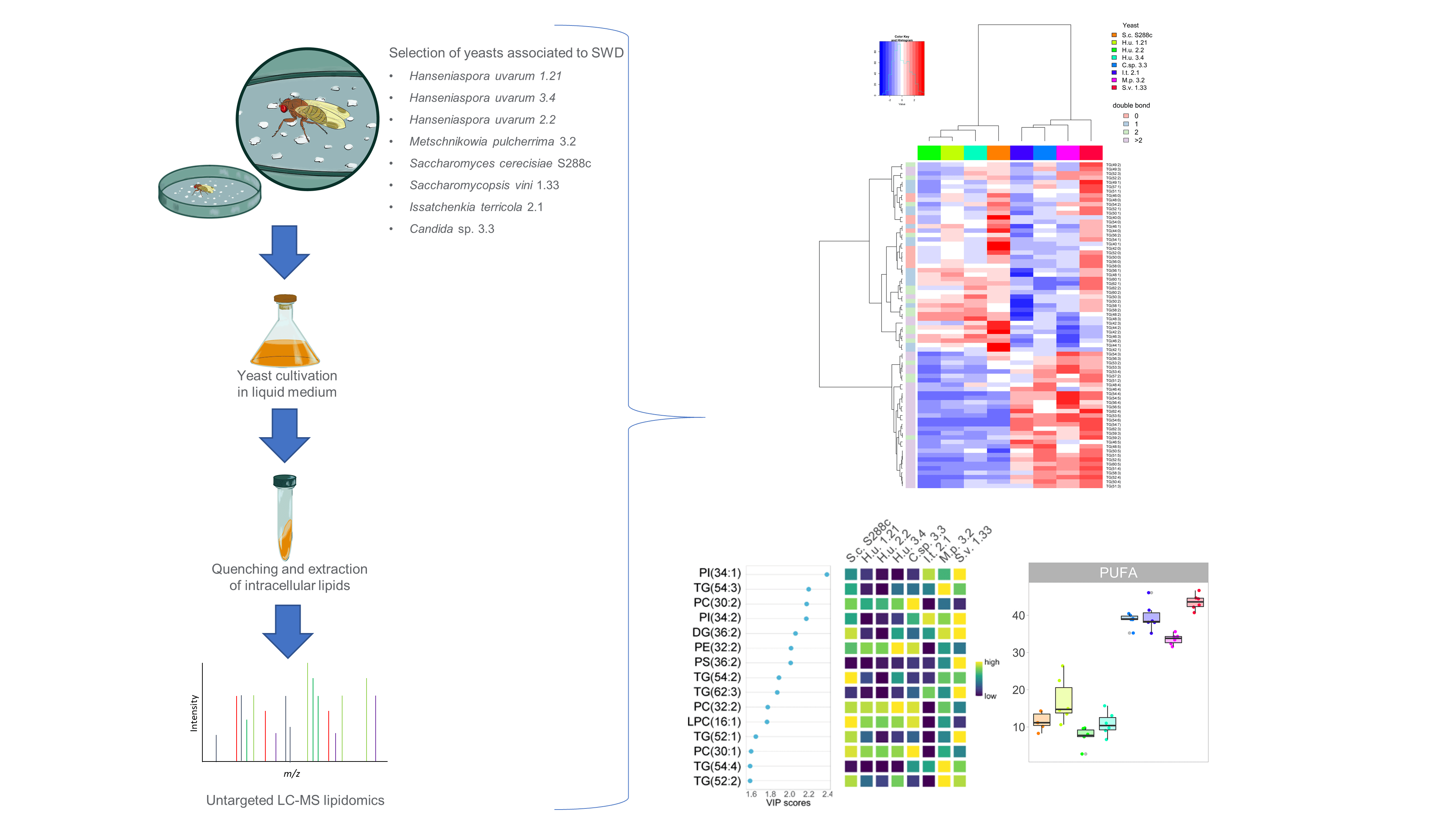
Bianchi, F. et al. Metabolites. 2020.
Service Advantages
- Comprehensive Lipid Coverage: Advanced LC-MS and GC-MS technologies enable precise analysis of a wide range of yeast lipids.
- High Stability and Sensitivity: Our robust platform ensures accurate and consistent lipid separation, identification, and quantification.
- Efficient and Cost-Effective: We provide reliable, fast, and affordable yeast lipidomics services, reducing research timelines.
Sample Submission Requirements
For non-targeted lipidomic analysis of yeast, samples should be fresh or frozen yeast cells in the logarithmic growth phase, with a minimum of 1×10⁷ cells per sample. Avoid repeated freeze-thaw cycles and store at -80°C. Samples must be shipped on dry ice to maintain low temperatures during transport. Ensure samples are free of contaminants, and specify any special treatments upon submission.
Applications
1. Lipid Metabolism Regulation
Reveals mechanisms of lipid synthesis, transformation, and degradation in yeast.
2. Stress Response Analysis
Studies lipid alterations in yeast under stress conditions like salinity, hypoxia, and nutrient deficiency.
3. Drug Development
Identifies potential drug targets related to lipid metabolism using the yeast model.
4. Cellular Physiology Research
Facilitates in-depth exploration of eukaryotic cell physiology using yeast models like Saccharomyces cerevisiae.
How to order?



