



Targeted Metabolomics Analysis Service
Targeted metabolomics is a study in which defined metabolites in a sample are identified and quantitatively analyzed. Quantitation and semi-quantitation of defined metabolites are undertaken through the use of internal standard compounds. Targeted metabolomics has an advantage of high specificity and accuracy. Thus, this method has been widely used to analyze and compare multiple targeted metabolites under different physiological states, and is a critical analytical method for discovery of new biomarker in metabolic diseases and study of early diagnosis of diseases.
MtoZ Biolabs offers targeted metabolomics analysis service using an LC-MS-based multiple reaction monitoring (MRM) and GC-MS-based single ion monitoring (SIM) metabolomics platforms, which have characteristics of high accuracy, specificity, and sensitivity. We guarantee accurate analysis of targeted metabolites, even in low abundance. With our optimized sample preparation methods, interference from high-abundance dominant metabolites can be hugely reduced, thus further increase the detecting sensitivity.
Analysis Workflow
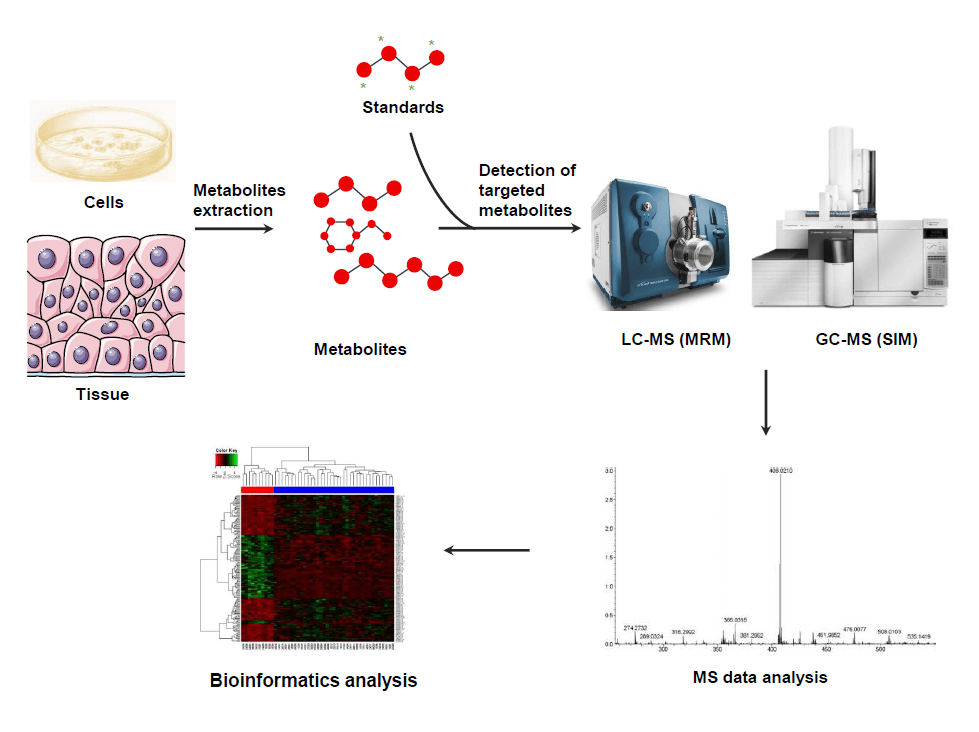
List of Targeted Metabolites Analysis Services
| Targeted Metabolomic Pathways | Carbohydrates & Glycolysis Pathways | ||
| Organic Compounds | Acyl CoAs | Amino Acid | Animal Hormones |
| Aldehydes | Bioamine | Bile Acids | |
| Carnitines | Carotenoids | Fatty Acids | |
| Flavone | Flax-Liganans | Meat Biomarkers | |
| Nucleotides | Oxysterols | Organic Acids | |
| Plant Hormone | Resveratrol | Tryptophan Metabolites | |
| Thiols | Vitamins & Coenzymes | ||
| Inorganic Compounds | Metal/Metallomics | Polyphenols |
Sample Submission Requirements
1. Cells and Microbes Samples: 1×10^7cellsor 100 μL/sample. Cellular activities should be terminated instantly, whereas maintaining the cell integrity.
2. Animal Tissues: 100 mg/sample. Collect soft tissues like brain, heart, liver, muscle, and skin. Immediately add preservative reagent and freeze at -80°C.
3. Plant Tissues: 200 mg/sample. Samples should be frozen in liquid nitrogen right after sample collection, and then transferred to -80°C for storage.
4. Serum Samples: Repeated freezing and thawing of sample must be eliminated. Serum samples should be settled down at room temperature for 30 min in the collection tube, and then transferred to centrifuge tube and centrifuged at 8,000 rpm, 5 min. After centrifugation, supernatant is aliquoted to freezing tubes with 200 uL/sample, and stored at -80°C.
5. Urine Samples: 2mL/sample. Urine samples can be aliquoted to centrifuge tubes with 2mL each tube, with addition 1/100 (w/v) sodium azide, and stored at -80°C.
6. Faeces Samples: 200 mg/sample.
Deliverables
1. Experiment Procedures
2. Parameters of Liquid Chromatography and Mass Spectrometer
3. MS Raw Data Files
4. MS Data Quality Checks
5. Metabolites Quantification Data
6. Bioinformatics Analysis (PCA, KEGG, etc.)
Related Services
Metabolomics
Quantitative Proteomics
Protein Analysis
• ATP Metabolism-Related Substances Analysis Service
ATP metabolism involves several key small molecules, including adenosine triphosphate (ATP), adenosine diphosphate (ADP), adenosine monophosphate (AMP), oxidized nicotinamide adenine dinucleotide (NAD+), reduced nicotinamide adenine dinucleotide (NADH), coenzyme A (CoA), acetyl coenzyme A (acetyl-CoA), and inorganic phosphate (Pi). ATP is the primary unit of energy transfer within cells, crucial for storing and transmitting chemical energy.
• Intestinal Microflora Metabolites Determination Analysis Service
The gut microbiota, also known as the gut microbiota, refers to the microorganisms that live in the digestive tract of humans and other animals, including bacteria and fungi. In the human body, without gut microbiota, some undigested carbohydrates cannot be consumed because certain types of gut microbiota have enzymes that human cells lack to break down certain polysaccharides.
• Polysaccharides Identification Analysis Service
Polysaccharides are macromolecular carbohydrates composed of multiple monosaccharide units linked by glycosidic bonds, often comprising hundreds or even thousands of these units. Along with nucleic acids, proteins, and lipids, polysaccharides are one of the four fundamental biomolecules, playing crucial roles in various biological processes.
Acetyl-CoA, an activated form of acetate, is formed by an acetyl group (CH3CO-) bonding to the thiol group of coenzyme A via a high-energy thioester bond. It is product of the decarboxylation of pyruvate produced by β-oxidation and glycolysis of fatty acid (FA). In the initial step of the tricarboxylic acid cycle (TAC), the acetyl group is transferred to oxaloacetate to form citrate, and this cycle is also called the "citric acid cycle". MtoZ Biolabs utilizes ACQUITY UPLC/TripleQuad5500 (Waters/AB Sciex) f
• Gangliosides Analysis Service
Gangliosides are a large class of complex lipids that are abundant in the neuronal cell membranes in the brain. These molecules consist of sphingolipids with one or more sialic acids attached to the sugar chain. As structural components of cell membranes, gangliosides have their two hydrocarbon chains embedded in the plasma membrane, while the oligosaccharides are located on the cell surface, serving as recognition points for extracellular substances or adjacent cells' surface molecules.
• Free Fatty Acids (FFA) Analysis Service
In animals, many dietary lipids are hydrolyzed into free fatty acids (FFAs) before absorption and subsequent lipid synthesis. Lipids undergo hydrolysis into FFAs by lipolytic enzymes such as hormone-sensitive lipase, lipoprotein lipase, and phospholipase A and C. These FFAs are then metabolized through various pathways including oxidation, desaturation, elongation, and re-esterification.
• ω-6 Fatty Acid Analysis Service
Polyunsaturated fatty acids (PUFAs) are primarily classified into ω-3 and ω-6 fatty acids. The difference between these two fatty acids lies in the position of the first double bond from the methyl end of the fatty acid chain. ω-6 fatty acids have a carbon-carbon double bond at the n-6 position.
• Olive Oil Phenolic Compounds Analysis Service
The health benefits of olive oil are well-documented, and it is widely believed that phenolic compounds found in olive oil contribute to some of these benefits. The types and concentrations of phenolic compounds vary significantly in plant tissues. Oleuropein is the most prominent phenolic compound in olives. The oleuropein molecule comprises three parts: a polyphenol, named 4-(2-hydroxyethyl)phenol-1,2-diol (also known as hydroxytyrosol or HT), an elenolic acid (a type of secoiridoid), and a glucose mol
• NAD Metabolism-Related Substance Analysis Service
NAD metabolism-related small molecules include oxidized nicotinamide adenine dinucleotide (NAD+), reduced nicotinamide adenine dinucleotide (NADH), oxidized nicotinamide adenine dinucleotide phosphate (NADP+), reduced nicotinamide adenine dinucleotide phosphate (NADPH), nicotinamide mononucleotide (NMN), nicotinamide (NAM), nicotinamide riboside (NaR), and adenosine triphosphate (ATP). NAD+, also known as coenzyme I, is an essential coenzyme in redox processes and participates in various physiological activ
• Lipoxygenase Product Analysis Service
Lipoxygenase is a family of non-heme, iron-containing enzymes. Most of these enzymes catalyze the dioxygenation of polyunsaturated fatty acids with cis,cis-1,4-pentadiene structures, synthesizing cell signaling molecules. These signaling molecules play various roles: they act as autocrine signals to regulate their parent cells, paracrine signals to regulate nearby cells, and endocrine signals to regulate distant cells.
How to order?



